Description
Purely symbolic memory state.
This memory state stores Jvm operands and local variables. Jvm Frames, see section 2.6.
A frame is used to store data and partial results, as well as to perform dynamic linking, return values for methods, and dispatch exceptions.
A new frame is created each time a method is invoked. A frame is destroyed when its method invocation completes, whether that completion is normal or abrupt (it throws an uncaught exception). Frames are allocated from the Java Virtual Machine stack (§2.5.2) of the thread creating the frame. Each frame has its own array of local variables (§2.6.1), its own operand stack (§2.6.2), and a reference to the run-time constant pool (§2.5.5) of the class of the current method.
A frame may be extended with additional implementation-specific information, such as debugging information.
The sizes of the local variable array and the operand stack are determined at compile-time and are supplied along with the code for the method associated with the frame (§4.7.3). Thus the size of the frame data structure depends only on the implementation of the Java Virtual Machine, and the memory for these structures can be allocated simultaneously on method invocation.
Only one frame, the frame for the executing method, is active at any point in a given thread of control. This frame is referred to as the current frame, and its method is known as the current method. The class in which the current method is defined is the current class. Operations on local variables and the operand stack are typically with reference to the current frame.
A frame ceases to be current if its method invokes another method or if its method completes. When a method is invoked, a new frame is created and becomes current when control transfers to the new method. On method return, the current frame passes back the result of its method invocation, if any, to the previous frame. The current frame is then discarded as the previous frame becomes the current one.
Note that a frame created by a thread is local to that thread and cannot be referenced by any other thread. The set of all frames and their values. FrameState objects are allocated on the heap and reference counted. The See the Rose::BinaryAnalysis::InstructionSemantics namespace for an overview of how the various memory state parts fit together.
Definition at line 61 of file FrameState.h.
#include <Rose/BinaryAnalysis/InstructionSemantics/BaseSemantics/FrameState.h>
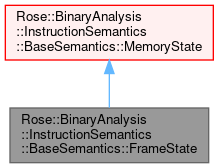
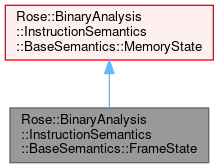
Public Types | |
| using | Super = MemoryState |
| Base type. | |
| using | Ptr = FrameStatePtr |
| Shared-ownership pointer. | |
 Public Types inherited from Rose::BinaryAnalysis::InstructionSemantics::BaseSemantics::MemoryState Public Types inherited from Rose::BinaryAnalysis::InstructionSemantics::BaseSemantics::MemoryState | |
| typedef MemoryStatePtr | Ptr |
| Shared-ownership pointer. | |
| Public Types inherited from Rose::BinaryAnalysis::InstructionSemantics::BaseSemantics::AddressSpace | |
| using | Ptr = AddressSpacePtr |
| Shared-ownership pointer. | |
| using | Purpose = AddressSpacePurpose |
| Purpose for the address space. | |
Public Member Functions | |
| MemoryStatePtr | create (const SValuePtr &addrProtoval, const SValuePtr &valProtoval) const override |
| Virtual allocating constructor. | |
| AddressSpacePtr | clone () const override |
| Deep-copy of this address space. | |
| void | clear () override |
| Clear memory. | |
| void | clearFrame () |
| bool | merge (const AddressSpacePtr &other, RiscOperators *addrOps, RiscOperators *valOps) override |
| Merge address spaces for data flow analysis. | |
| SValuePtr | readMemory (const SValuePtr &address, const SValuePtr &dflt, RiscOperators *addrOps, RiscOperators *valOps) override |
| Read a value from memory. | |
| void | writeMemory (const SValuePtr &address, const SValuePtr &value, RiscOperators *addrOps, RiscOperators *valOps) override |
| Write a value to memory. | |
| SValuePtr | peekMemory (const SValuePtr &address, const SValuePtr &dflt, RiscOperators *addrOps, RiscOperators *valOps) override |
| Read a value from memory without side effects. | |
| SValuePtr | readLocal (size_t index) const override |
| void | writeLocal (size_t index, const SValuePtr &value) override |
| SValuePtr | peekOperand (size_t depth=0) override |
| Peek at an operand value. | |
| SValuePtr | popOperand () override |
| Pop an operand value. | |
| void | pushOperand (const SValuePtr &value) override |
| Push an operand value. | |
| SValuePtr | currentException () const |
| The exception currently associated with this frame. | |
| void | currentException (const SValuePtr &value) |
| void | hash (Combinatorics::Hasher &, RiscOperators *addrOps, RiscOperators *valOps) const override |
| Hash this address space. | |
| void | print (std::ostream &, Formatter &) const override |
| Print an address space. | |
| ByteCode::Method::Ptr | method () const |
| SValuePtr | createArgument (const std::string &descriptor, size_t argIdx) |
| const Sawyer::Optional< Address > & | returnAddress () const |
| void | returnAddress (Address) |
| size_t | frameId () const |
| void | frameId (size_t) |
| std::string | frameLabel () const |
| std::string | frameName () const |
| std::string | label () const override |
| Label for this address space. | |
| Public Member Functions inherited from Rose::BinaryAnalysis::InstructionSemantics::BaseSemantics::MemoryState | |
| SValuePtr | get_addr_protoval () const |
| Return the address protoval. | |
| SValuePtr | get_val_protoval () const |
| Return the value protoval. | |
| MergerPtr | merger () const |
| Property: Merger. | |
| void | merger (const MergerPtr &) |
| Property: Merger. | |
| bool | byteRestricted () const |
| Indicates whether memory cell values are required to be eight bits wide. | |
| void | byteRestricted (bool) |
| Indicates whether memory cell values are required to be eight bits wide. | |
| ByteOrder::Endianness | get_byteOrder () const |
| Memory byte order. | |
| void | set_byteOrder (ByteOrder::Endianness) |
| Memory byte order. | |
| Public Member Functions inherited from Rose::BinaryAnalysis::InstructionSemantics::BaseSemantics::AddressSpace | |
| virtual SValuePtr | read (const AddressSpaceAddress &, const SValuePtr &dflt, RiscOperators &addrOps, RiscOperators &valOps) |
| Read a value from the address space. | |
| virtual SValuePtr | peek (const AddressSpaceAddress &, const SValuePtr &dflt, RiscOperators &addrOps, RiscOperators &valOps) |
| Read without causing side effects. | |
| virtual void | write (const AddressSpaceAddress &, const SValuePtr &value, RiscOperators &addrOps, RiscOperators &valOps) |
| Write a value to an address space. | |
| std::string | printableName () const |
| Printable name for this address space. | |
| Purpose | purpose () const |
| Property: Purpose of this address space. | |
| void | purpose (Purpose) |
| Property: Purpose of this address space. | |
| const std::string & | name () const |
| Property: Name for this address space. | |
| void | name (const std::string &) |
| Property: Name for this address space. | |
| void | print (std::ostream &, const std::string &prefix="") const |
| Print an address space. | |
| WithFormatter | with_format (Formatter &) |
| Used for printing address spaces with formatting. | |
| WithFormatter | operator+ (Formatter &) |
| Used for printing address spaces with formatting. | |
| WithFormatter | operator+ (const std::string &linePrefix) |
| Used for printing address spaces with formatting. | |
Static Public Member Functions | |
| static FrameStatePtr | instance (const SValuePtr &, const Sawyer::Optional< Address > &, const ByteCode::Method::Ptr &) |
| Instantiate a new empty frame state on the heap. | |
| static FrameStatePtr | promote (const AddressSpacePtr &) |
| Convert pointer to a FrameState pointer. | |
| static std::string | argumentDescriptor (const std::string &descriptor, size_t argIdx) |
| static size_t | newFrameId () |
| static bool | isCategory1 (const SValuePtr &) |
| static bool | isCategory2 (const SValuePtr &) |
| static bool | isCategory2Tail (const SValuePtr &) |
| Static Public Member Functions inherited from Rose::BinaryAnalysis::InstructionSemantics::BaseSemantics::MemoryState | |
| static MemoryStatePtr | promote (const AddressSpacePtr &) |
Protected Member Functions | |
| FrameState (const SValue::Ptr &valProtoval, const Sawyer::Optional< Address > &, const ByteCode::Method::Ptr &) | |
| FrameState (const FrameState &other) | |
| Protected Member Functions inherited from Rose::BinaryAnalysis::InstructionSemantics::BaseSemantics::MemoryState | |
| MemoryState (Purpose, const std::string &name, const SValuePtr &valProtoval) | |
| MemoryState (const SValuePtr &addrProtoval, const SValuePtr &valProtoval) | |
| MemoryState (const MemoryStatePtr &other) | |
| Protected Member Functions inherited from Rose::BinaryAnalysis::InstructionSemantics::BaseSemantics::AddressSpace | |
| AddressSpace (Purpose, const std::string &name) | |
| AddressSpace (const AddressSpace &) | |
| AddressSpace & | operator= (const AddressSpace &)=delete |
Member Typedef Documentation
◆ Super
Base type.
Definition at line 64 of file FrameState.h.
◆ Ptr
Shared-ownership pointer.
Definition at line 67 of file FrameState.h.
Member Function Documentation
◆ create()
|
overridevirtual |
Virtual allocating constructor.
Allocates and constructs a new MemoryState object having the same dynamic type as this object. A prototypical SValue must be supplied and will be used to construct any additional SValue objects needed during the operation of a MemoryState. Two prototypical values are supplied, one for addresses and another for values stored at those addresses, although they will almost always be the same.
Implements Rose::BinaryAnalysis::InstructionSemantics::BaseSemantics::MemoryState.
◆ clone()
|
overridevirtual |
Deep-copy of this address space.
Implements Rose::BinaryAnalysis::InstructionSemantics::BaseSemantics::AddressSpace.
◆ promote()
|
static |
Convert pointer to a FrameState pointer.
Converts x to a FrameStatePtr and asserts that it is non-null.
◆ clear()
|
overridevirtual |
Clear memory.
Removes all memory cells from this memory state.
Implements Rose::BinaryAnalysis::InstructionSemantics::BaseSemantics::MemoryState.
◆ merge()
|
overridevirtual |
Merge address spaces for data flow analysis.
Merges the other address space into this address space, returning true if this space changed.
Implements Rose::BinaryAnalysis::InstructionSemantics::BaseSemantics::AddressSpace.
◆ readMemory()
|
overridevirtual |
Read a value from memory.
Consults the memory represented by this MemoryState object and returns a semantic value. Depending on the semantic domain, the value can be a value that is already stored in the memory state, a supplied default value, a new value constructed from some combination of existing values and/or the default value, or anything else. For instance, in a symbolic domain the address could alias multiple existing memory locations and the implementation may choose to return a McCarthy expression. Additional data (such as SMT solvers) may be passed via the RiscOperators argument.
The size of the value being read does not necessarily need to be equal to the size of values stored in the memory state, though it typically is(1). For instance, an implementation may allow reading a 32-bit little endian value from a memory state that stores only bytes. A RiscOperators object is provided for use in these situations.
In order to support cases where an address does not match any existing location, the dflt value can be used to initialize a new memory location. The manner in which the default is used depends on the implementation. In any case, the width of the dflt value determines how much to read.
Footnote 1: A MemoryState::readMemory() call is the last in a sequence of delegations starting with RiscOperators::readMemory(). The designers of the MemoryState, State, and RiscOperators subclasses will need to coordinate to decide which layer should handle concatenating values from individual memory locations.
Implements Rose::BinaryAnalysis::InstructionSemantics::BaseSemantics::MemoryState.
◆ writeMemory()
|
overridevirtual |
Write a value to memory.
Consults the memory represented by this MemoryState object and possibly inserts the specified value. The details of how a value is inserted into a memory state depends entirely on the implementation in a subclass and will probably be different for each semantic domain.
A MemoryState::writeMemory() call is the last in a sequence of delegations starting with RiscOperators::writeMemory(). The designers of the MemoryState, State, and RiscOperators will need to coordinate to decide which layer (if any) should handle splitting a multi-byte value into multiple memory locations.
Implements Rose::BinaryAnalysis::InstructionSemantics::BaseSemantics::MemoryState.
◆ peekMemory()
|
overridevirtual |
Read a value from memory without side effects.
This is similar to readMemory except there are no side effects. The memory state is not modified by this function.
Implements Rose::BinaryAnalysis::InstructionSemantics::BaseSemantics::MemoryState.
◆ readLocal()
|
overridevirtual |
Reimplemented from Rose::BinaryAnalysis::InstructionSemantics::BaseSemantics::MemoryState.
◆ writeLocal()
|
overridevirtual |
Reimplemented from Rose::BinaryAnalysis::InstructionSemantics::BaseSemantics::MemoryState.
◆ peekOperand()
|
overridevirtual |
Peek at an operand value.
Reimplemented from Rose::BinaryAnalysis::InstructionSemantics::BaseSemantics::MemoryState.
◆ popOperand()
|
overridevirtual |
Pop an operand value.
Reimplemented from Rose::BinaryAnalysis::InstructionSemantics::BaseSemantics::MemoryState.
◆ pushOperand()
|
overridevirtual |
Push an operand value.
Reimplemented from Rose::BinaryAnalysis::InstructionSemantics::BaseSemantics::MemoryState.
◆ hash()
|
overridevirtual |
Hash this address space.
Hashes this address space by appending its data to the specified hasher. The goal is to identify when two address spaces are the "same" and allow certain kinds of analyses to take shortcuts. The address space purpose and name are not included in the hash. Separate RISC operators are passed for the addresses and values of this address space and are used if the hashing requires any operations on the addresses or values.
Implements Rose::BinaryAnalysis::InstructionSemantics::BaseSemantics::AddressSpace.
◆ print()
|
overridevirtual |
Print an address space.
The output most likely occupies more than one line and each emitted line will be terminated with a line feed.
Implements Rose::BinaryAnalysis::InstructionSemantics::BaseSemantics::AddressSpace.
◆ label()
|
overridevirtual |
Label for this address space.
The label may be used in place of the name where circumstances dictate.
Reimplemented from Rose::BinaryAnalysis::InstructionSemantics::BaseSemantics::AddressSpace.
The documentation for this class was generated from the following file: